








If you want to open up new scope for your own production now and you don’t want to invest in a new machine right away, you might be well served by extending the processing spectrum on an existing machine. Tennille Aron from Food Review spoke to Lothar Barth, director Sales International at Somic Verpackungsmaschinen GmbH & Co. KG from Amerang about the flexibility of their machines.
Q. What options are there for extending the format spectrum of a Somic machine?
A. We see three different scenarios when we look at changing the processing spectrum of our machines out in the field. The simplest case is pre-programmed. We can set additional format parameters via our remote maintenance function. The second case is when we have to produce new format parts for the existing machine, which can then be installed in the machine by the customer. In the third case, a conversion is required, which can only be carried out by Somic’s own personnel onsite.
Q. How are the retrofit tasks organised in your plant?
A. We have our own retrofitting department that follows the projects from the first request of the customer to the realisation of the project. Retrofitting is the most difficult task in mechanical engineering. Our Retrofit & Upgrade department is a special force. There we only employ the most experienced staff who have been working in mechanical engineering and design for a long time.
Q. Which machines can be retrofitted?
A. Demands for retrofits concern recently delivered machines, but also machines from the 1990s. Not only do we rely on specially trained staff, we even go one step further. We manufacture the parts on a specially equipped production line. Customers with retrofitting orders are assigned a special project manager who supervises the order from order clarification to delivery and commissioning. This enables close communication and the customer receives comprehensive support.
Q. Can you explain the processes in more detail?
A. Of course, preferably with a case study. On a machine delivered in 2016, 13 formats have already been configured in advance, and the machine is prepared for this. Now, two more formats were added in 2018. In order to realise a precise folding process for these carton formats, the folding flaps had to be modified. This increased the flexibility for our customer. This made it possible to better take into account the optical characteristics of printed cartons and their display tasks or specifications from the trade for placement.
Q. What are the options when retrofitting a machine?
A. The simplest case for the retrofit team is for the user to remain within the format range that was specified when the machine was purchased. With the dimensions: x length x width x height for product and carton, the settings of the format parts are stored in the operating panel. We simply connect to the machine in remote maintenance mode and program the desired new formats in the product and carton pre-selection.
Q. Can’t you just program these adjustments yourself?
A. The controller is the key to the machine’s operation. It is not advisable to intervene in these preset sequences and settings yourself. Even if we do, it’s not a big deal for the customer. Changes of this kind are usually completed within a few hours, including the subsequent function check, and can be carried out on tray, wraparound or tray/lid machines of type 424 from about the year of manufacture. In about 30% of all requests for retrofits, we are able to provide the customer with the necessary format expansion very quickly.
Q. What must be done if the new formats differ massively from the existing ones?
A. If you deviate massively from the existing formats, an average of 20 parts are affected by a format expansion. The required parts are specified by the Retrofit & Upgrade project team and produced on the separate production line. We produce the parts in batch size 1 directly related to the customer’s application. Some of the individual format parts can be installed in the machine by the customer themselves. With the help of the Quick-Change technique invented by Somic, the exchange can be carried out without tools.
Q. What is the Quick-Change technique?
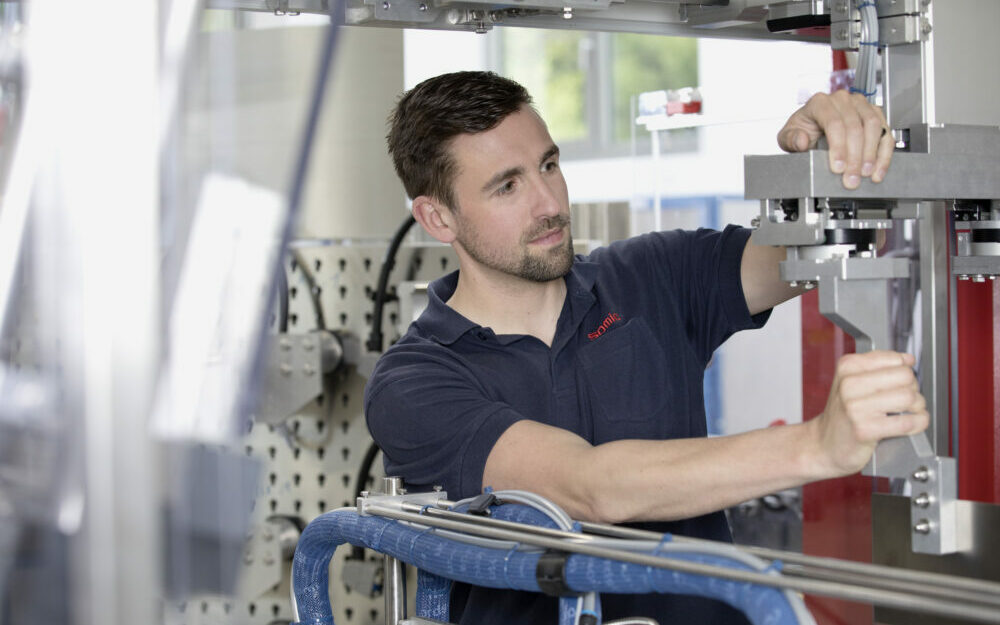
A. The Quick-Change technique uses easy-to-open levers at the positions for format changeovers, which are released manually by the operator. If the exchange part is inserted, there is a clear installation situation. Mistakes or errors during installation are ruled out. The operator then locks the lever and fixes the format part securely.
Q. Must a completely new format set always be used for a retrofit?
A. With the help of our documentation we can determine exactly which assemblies are affected by a change. For example, if a new product grouping is desired, everything may still fit well in the case of the lamella chain, but a change may be necessary in the case of the push-off comb. Also, in the case of the carton feed, the processed carton spectrum and the guides must be considered exactly in relation to each individual format. We always attach great importance to this flexibility.


